
Context.dev review
A hosted web scraping and brand-intelligence API that returns Markdown, JSON, and company data from a URL or domain.
A hosted web scraping and brand-intelligence API that returns Markdown, JSON, and company data from a URL or domain.
Reviewed by

Vincent Edes · Founder & reviewer
Last reviewed Sep 3, 2026
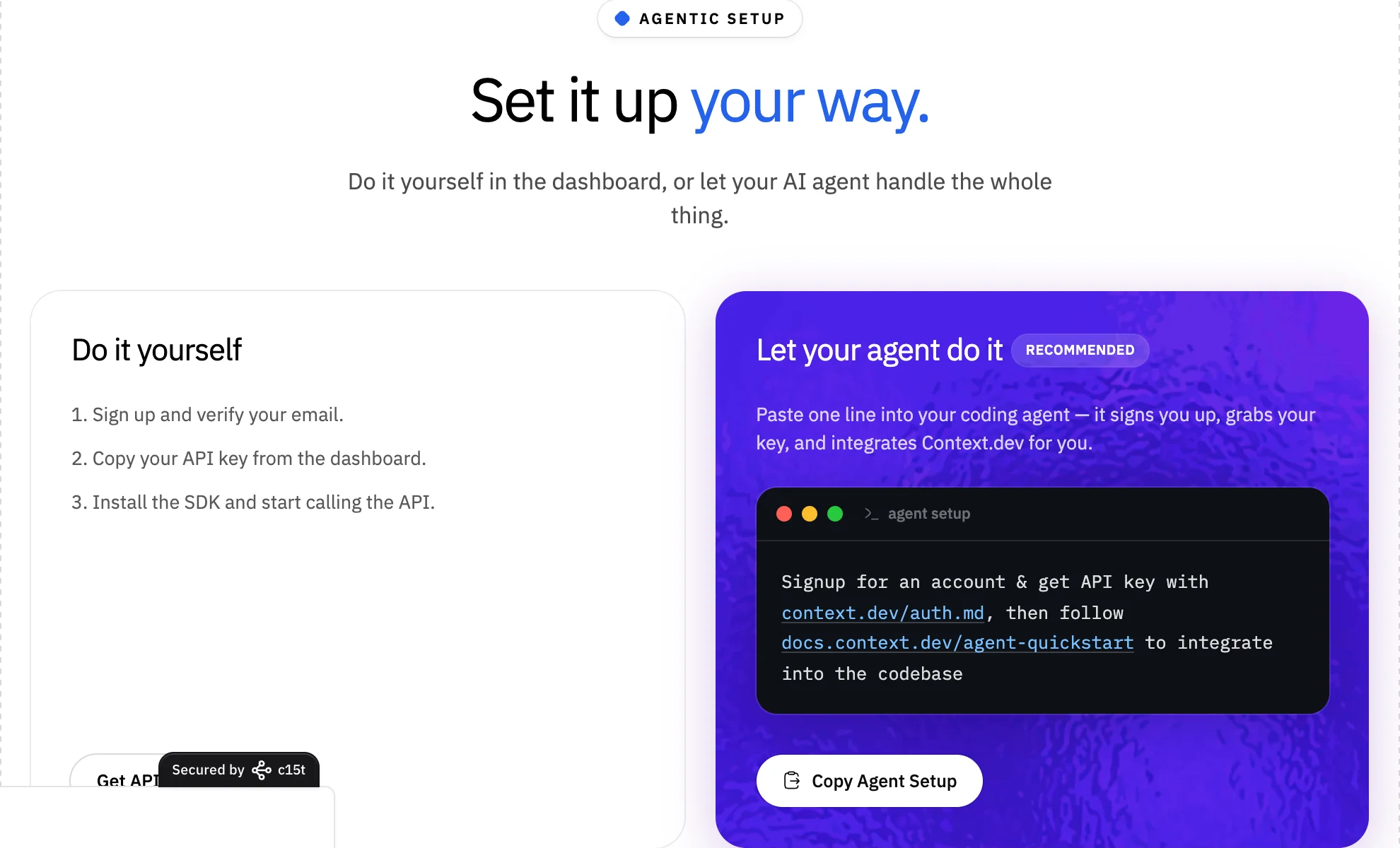
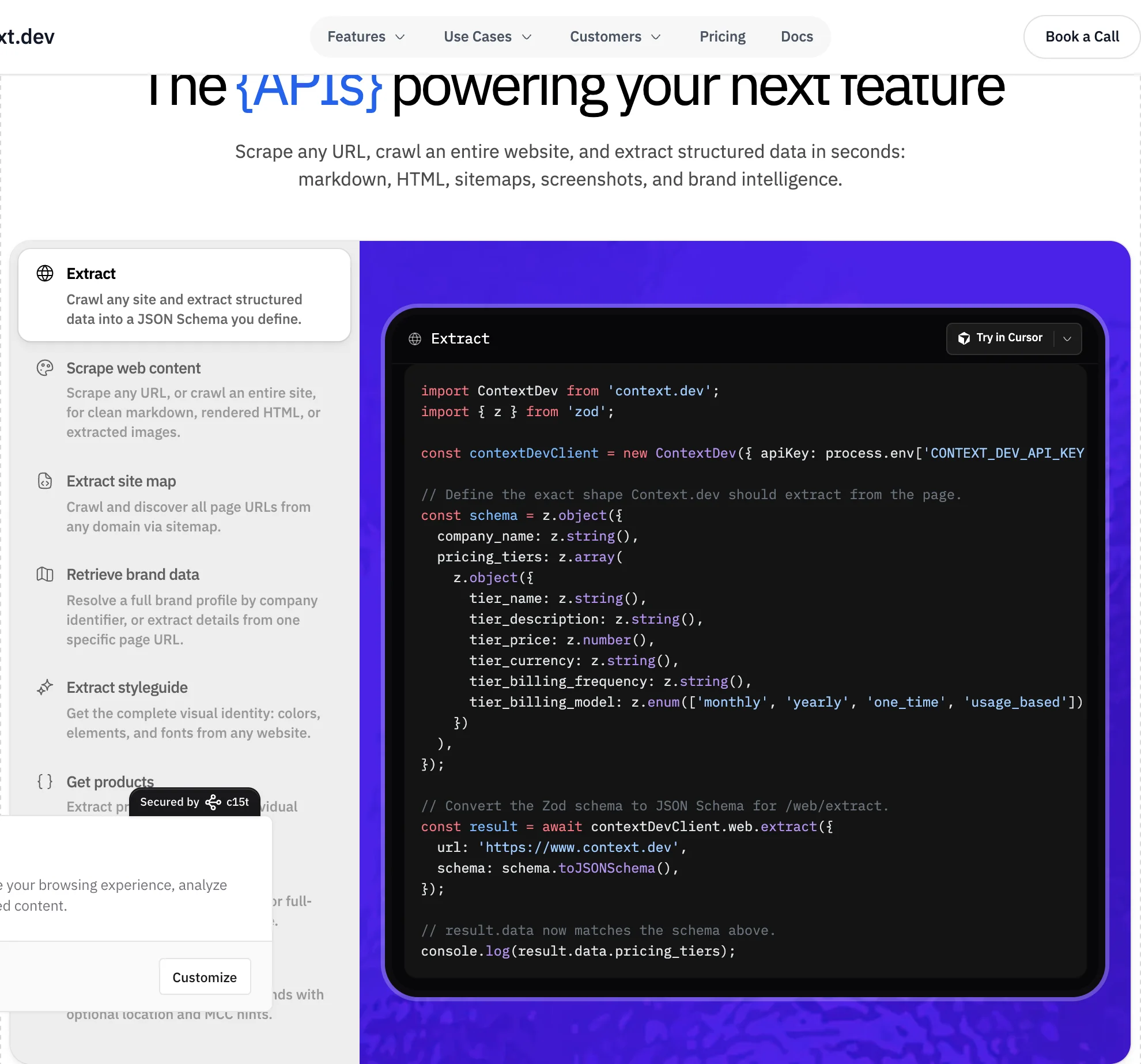
Set it up your way: sign up in the dashboard or paste one line into your coding agent.
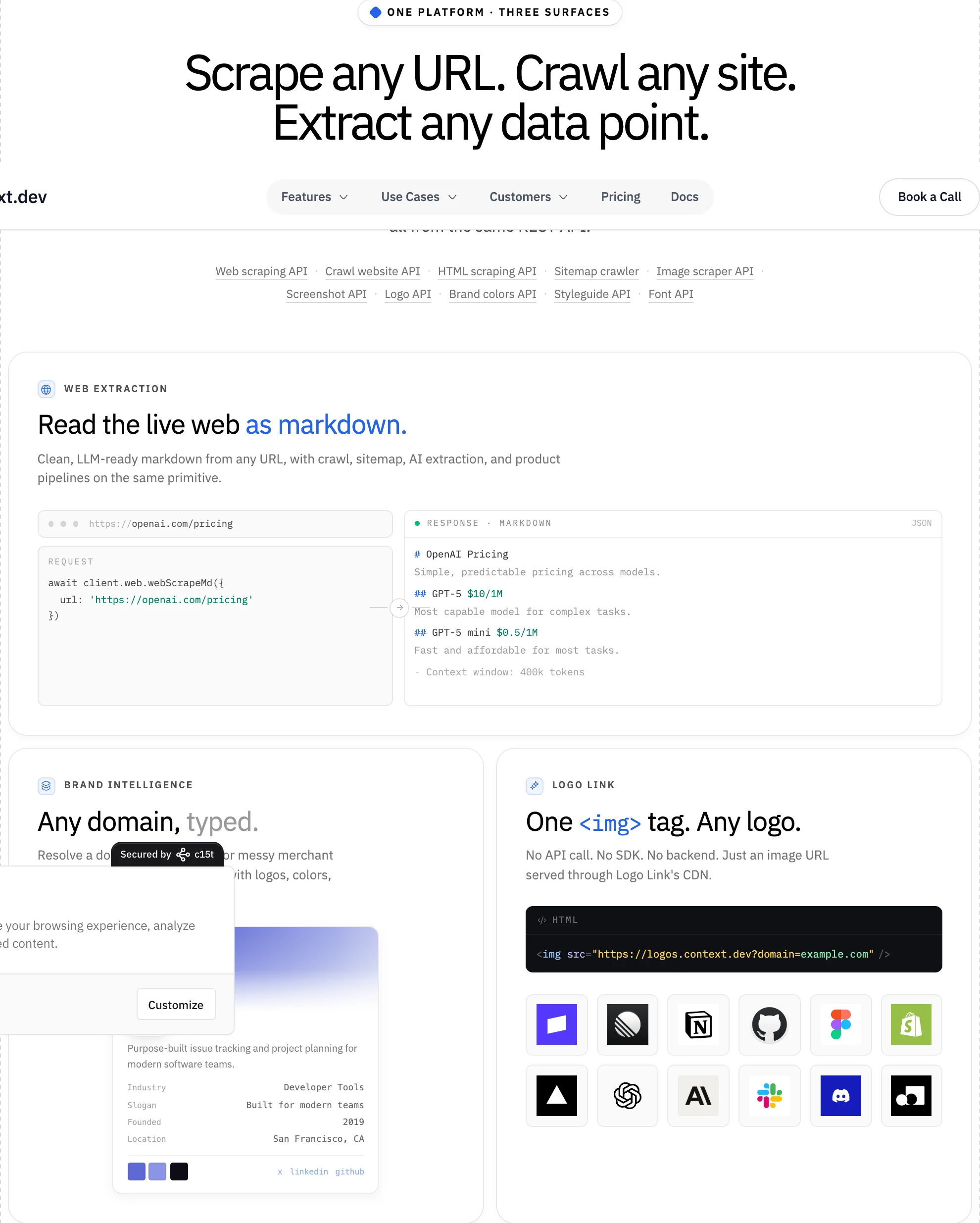
Context.dev is a hosted web scraping and brand data API created by Yahia Bakour. It started as Brand.dev and expanded into full web extraction for YC Summer 2026. You pass a URL to get clean Markdown, rendered HTML, screenshots, or structured JSON, and you pass a domain to retrieve verified logos, brand colors, fonts, and company industry codes.
Pricing is success-based. A standard page scrape costs 1 credit, and failed or blocked requests are not billed. JavaScript rendering, stealth execution, and residential proxy rotation are included without credit multipliers, but optional browser actions require a paid plan and bump the request to 2 credits while bypassing the scrape cache (see Scrape Websites).
For typed extraction, the /web/extract endpoint lets you provide a JSON Schema so the API returns structured data for 10 credits per successful call (docs: Extract Structured Data). Brand retrieval is also 10 credits per request, and it can reuse cached results up to its documented maxAgeMs (docs: Get Brand Data). If you want to avoid cold-cache latency in onboarding flows, Context.dev's documented pattern is to warm the brand cache first via POST /utility/prefetch.
Paid plans start at $25 per month for 10,000 credits on Developer, scaling to $149 for 200,000 credits on Pro and $499 for 1,000,000 credits on Scale. Annual billing gives you two months free, effectively reducing your year cost to ten months. With our verified Context.dev promo code, you get 25% off for 6 months, so Developer drops to $18.75 per month. Context.dev runs as managed cloud only (no self-host option).
DEV Community testers describe a strong scheduled-scraping fit for RAG, and warn that brand endpoints can consume credits faster if called unintentionally (source: DEV Community). If you only need crawling and live search, compare Firecrawl; for proxy-first HTML, compare ScrapingBee.
What's included with Context.dev
- Markdown, HTML, screenshots, and JSON Schema extraction from URLs
- One credit per page with JavaScript rendering and proxies included
- Company profiles with verified logos, fonts, colors, and industry codes
- Official SDKs for TypeScript, Python, Ruby, Go, and PHP
- Direct Model Context Protocol integration for AI assistants
Our review
Context.dev pros and cons
Pros
- One credit includes JavaScript rendering and residential proxies
- Scraping and brand intelligence share a single provider
- Failed or blocked requests are never billed
- Official SDKs in five languages with MCP support
Cons
- Hosted cloud platform with no self-hosted deployment option
- Brand intelligence and extraction calls cost ten credits each
- Cold brand lookups can take up to five minutes
- Brand cache refresh updates about every 3 months
- Browser actions require paid plans and cost 2 credits
Best for
Founders building AI agents needing clean Markdown and verified brand data.
Skip if
You require an open-source tool that you can self-host on your own infrastructure, or your workload consists purely of scraping millions of standard HTML pages where a low-tier proxy service is cheaper.
Score breakdown
- Features: 4.5 out of 5
- The platform combines page scraping, full-page screenshots, JSON Schema extraction, and brand intelligence within one API endpoint. It also supports official MCP for AI agents. Browser `actions` exist only on paid plans, cost 2 credits, and bypass the scrape cache, and Context.dev is offered as a managed cloud service with no self-host option.
- Reliability: 4.7 out of 5
- Every plan includes stealth browser rendering, automatic proxy escalation, and anti-bot bypass at no extra credit cost, and the pricing page confirms you are not billed for failed or blocked requests. The changelog shows a 20 percent latency reduction shipped across all endpoints, and the platform added cache metadata headers so you can verify freshness per response. Cold brand lookups can take longer on first hit, but the free prefetch endpoint and explicit error codes (`COLD_DOMAIN_TIMEOUT_TOO_LOW`) give you clear control over that trade-off.
- Value: 4.4 out of 5
- The Developer tier at $25 for 10,000 credits provides strong value because every single credit covers a fully rendered page with residential proxies. However, higher-level calls like Brand Retrieve and structured JSON extraction cost ten credits each, which can consume a smaller plan quickly if used as your primary workload.
- Docs & SDKs: 4.7 out of 5
- The documentation at docs.context.dev covers every REST endpoint with runnable examples in five languages, plus dedicated guides for prefetching, rate limits, best practices, and troubleshooting. The pricing page publishes per-endpoint credit costs without hidden multipliers, and the changelog is updated multiple times per week with concrete technical detail. MCP configuration and agent auth each have their own guide.
- Ease of use: 4.8 out of 5
- You export one API key, install the SDK for your language, and call a single endpoint. The docs include copy-paste examples for TypeScript, Python, Ruby, Go, and PHP, and the MCP config is a one-liner for Cursor or Claude. Cold brand lookups are the only setup nuance: the docs provide a free prefetch endpoint and a dedicated troubleshooting page so you can handle it before it reaches your users.
The platform combines page scraping, full-page screenshots, JSON Schema extraction, and brand intelligence within one API endpoint. It also supports official MCP for AI agents. Browser `actions` exist only on paid plans, cost 2 credits, and bypass the scrape cache, and Context.dev is offered as a managed cloud service with no self-host option.
Every plan includes stealth browser rendering, automatic proxy escalation, and anti-bot bypass at no extra credit cost, and the pricing page confirms you are not billed for failed or blocked requests. The changelog shows a 20 percent latency reduction shipped across all endpoints, and the platform added cache metadata headers so you can verify freshness per response. Cold brand lookups can take longer on first hit, but the free prefetch endpoint and explicit error codes (`COLD_DOMAIN_TIMEOUT_TOO_LOW`) give you clear control over that trade-off.
The Developer tier at $25 for 10,000 credits provides strong value because every single credit covers a fully rendered page with residential proxies. However, higher-level calls like Brand Retrieve and structured JSON extraction cost ten credits each, which can consume a smaller plan quickly if used as your primary workload.
The documentation at docs.context.dev covers every REST endpoint with runnable examples in five languages, plus dedicated guides for prefetching, rate limits, best practices, and troubleshooting. The pricing page publishes per-endpoint credit costs without hidden multipliers, and the changelog is updated multiple times per week with concrete technical detail. MCP configuration and agent auth each have their own guide.
You export one API key, install the SDK for your language, and call a single endpoint. The docs include copy-paste examples for TypeScript, Python, Ruby, Go, and PHP, and the MCP config is a one-liner for Cursor or Claude. Cold brand lookups are the only setup nuance: the docs provide a free prefetch endpoint and a dedicated troubleshooting page so you can handle it before it reaches your users.
Creator

Yahia Bakour
Follow on XPricing
Pro
Popular$149/month
Per month · 200,000 monthly credits for scaling applications with steady traffic. Billed at $149 per month, or save two months worth of fees on an annual plan.
- 200,000 API credits per month
- Overage $9 per 10,000 credits
- 300 API calls per minute
- Email and Slack support, spend controls
Price last checked: September 14, 2026
Documentation
Alternative web scraping APIs
If Context.dev is not the right fit, these are the closest alternatives based on pricing, features, and use case.

Firecrawl
Best for AI agentsChoose Firecrawl if your workflow centers on recursive crawling, web search, and browser automation for AI agents, and you value a renewable monthly free plan.
ScrapingBee
Choose ScrapingBee if your application already has custom HTML parsers and you primarily need headless Chrome with rotating residential proxies.
Related articles & comparisons
Frequently asked questions
What is Context.dev?
Context.dev is a web scraping and brand data API designed for modern software applications and AI agents. By sending a URL or domain name to the API, you can retrieve clean Markdown, rendered HTML, full-page screenshots, schema-validated JSON, or complete company profiles containing logos, brand typography, and official industry codes.
How much does Context.dev cost?
The free trial gives you 250 one-time credits with a personal email or 500 credits with a corporate email, letting you test the API with no credit card required. The Developer plan costs $25 per month for 10,000 credits, while the Pro tier costs $149 per month for 200,000 credits and the Scale plan costs $499 per month for 1,000,000 credits. Choosing annual billing gives you two months free, meaning you effectively pay for ten months across the full year.
How does Context.dev compare to Firecrawl?
Firecrawl is designed primarily for recursive web crawling, search-assisted scraping, and browser interactions for AI pipelines, and it includes 1,000 free credits that refill every month. Context.dev specializes in combining reliable page scraping with structured brand intelligence, providing verified company logos, color palettes, and firmographic metadata alongside its Markdown extraction endpoints.
Can I self-host Context.dev on my own servers?
No, Context.dev is offered exclusively as a managed cloud service. While you retain complete ownership of the Markdown and JSON data returned by every request, the crawling infrastructure, proxy rotation, and browser instances run entirely on their managed servers.
Sources & research
Claims in our review are checked against primary sources, changelogs, official documentation, and founder updates.
- context.dev
- context.dev/pricing
- docs.context.dev/introduction
- context.dev/blog/brand-dev-is-now-context-dev
- docs.context.dev/guides/scrape-websites-to-markdown
- docs.context.dev/guides/extract-structured-data-from-websites
- docs.context.dev/guides/get-brand-data
- docs.context.dev/optimization/prefetching
- docs.context.dev/optimization/best-practices
- dev.to/rankertoolai/i-tested-contextdev-for-30-days-honest-review-8210-5717
- context.dev/startup-discount
- context.dev/auth.md
- huzzler.so/deals/context-dev-promo-code
- news.ycombinator.com/item