ScrapingBee review
A classic web scraping API with headless Chrome, rotating proxies, and credit multipliers for JavaScript and stealth.
A classic web scraping API with headless Chrome, rotating proxies, and credit multipliers for JavaScript and stealth.
Reviewed by

Vincent Edes · Founder & reviewer
Last reviewed Sep 3, 2026
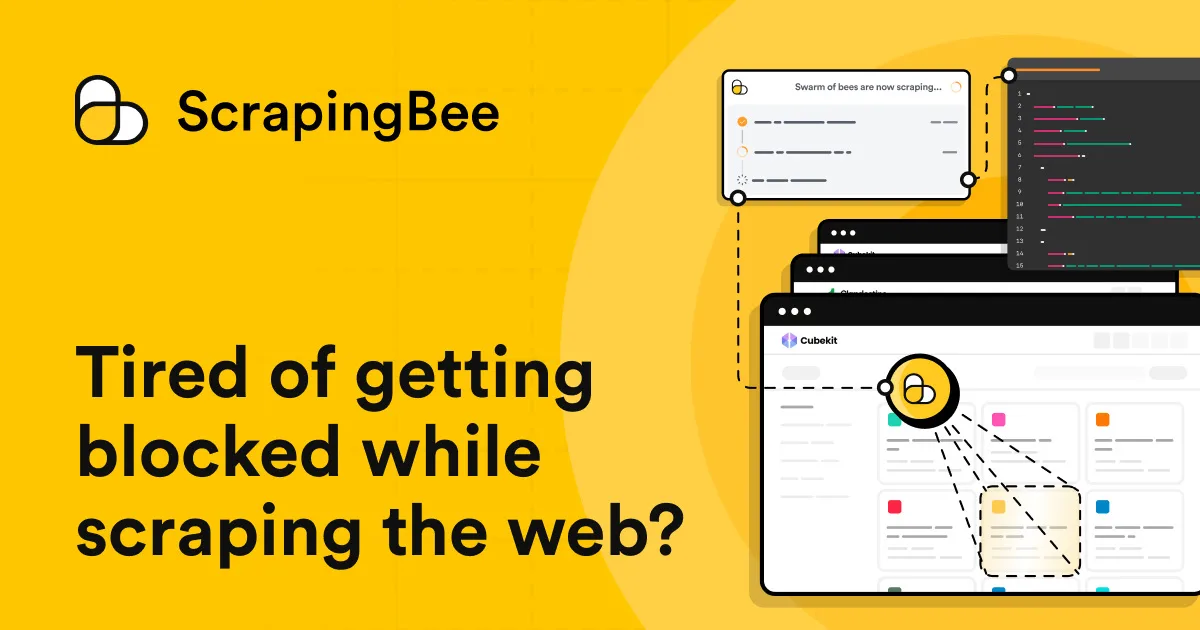
ScrapingBee platform overview highlighting rotating proxies, headless Chrome, and credit-based HTML endpoints.
ScrapingBee is a classic web scraping API created in 2019 by Pierre de Wulf and Kevin Sahin. It handles headless browser automation and residential proxy rotation for developers who already maintain custom HTML parsers. The platform focuses on reliable raw HTML retrieval and screenshot capture, making it a dependable utility for traditional web harvesting rather than an AI-focused context layer.
The critical factor in evaluating ScrapingBee is its credit multiplier model. Headless Chrome rendering is enabled by default on every request and costs five credits per page. While you can disable JavaScript to pay a single credit for static pages, routing requests through residential or stealth proxies increases consumption to 25 or 75 credits per page.
Pricing on their pricing page begins at $19 per month for the Hobby plan with 75,000 credits and 25 concurrent connections, scaling to Freelance at $49 for 250,000 credits and Business at $249 for 3,000,000 credits. All plans exclude VAT, and new accounts receive 1,000 free credits to test the API with no credit card required. Unused credits expire at renewal, though active subscribers can purchase one-time credit add-ons if needed.
ScrapingBee is a practical fit if you need reliable headless Chrome rendering through an HTTP endpoint and can disable JavaScript on static targets. If you prefer flat pricing where one credit always covers a rendered page, see Context.dev. For published per-domain rate cards on difficult sites, explore ScraperAPI. View the complete list in our web scraping API catalog.
What's included with ScrapingBee
- Headless Chrome rendering for single-page apps and dynamic pages
- Global rotating residential and datacenter proxy network
- Dedicated Google Search API with structured result parsing
- Full-page screenshot capture and CSS data extraction rules
- Standard HTTP proxy gateway mode for existing scraping tools
Our review
ScrapingBee pros and cons
Pros
- Reliable headless Chrome rendering with rotating residential proxies
- Dedicated Google search result and screenshot capture endpoints
- Affordable entry plan when JavaScript execution is turned off
- Proxy gateway mode integrates easily with existing scraping scripts
Cons
- JavaScript rendering costs five credits by default
- Stealth and residential proxies significantly increase request costs
- Lacks native Model Context Protocol support for agents
- Unused credits do not roll over across months
Best for
Developers managing their own HTML parsers who want headless Chrome.
Skip if
You are building an AI agent that requires native Markdown and search endpoints, or you want to avoid monitoring request-level credit multipliers.
Score breakdown
- Features: 4.0 out of 5
- ScrapingBee delivers a mature feature set for traditional web scraping, including headless Chrome rendering, rotating proxy pools, full-page screenshots, Google search results, and CSS extraction rules. It does not, however, offer native Model Context Protocol support, Markdown conversion pipelines, or brand intelligence.
- Reliability: 4.3 out of 5
- The combination of headless Chrome and tiered proxy networks makes ScrapingBee effective at retrieving content from protected websites. Its overall reliability depends on which proxy tier you choose, with premium residential and stealth proxies delivering higher success rates at the expense of higher credit multipliers.
- Value: 3.5 out of 5
- The $19 Hobby plan appears economical at first glance, but the default five-credit charge for JavaScript rendering reduces the practical capacity to 15,000 requests. While disabling JavaScript restores full value on static sites, invoking stealth proxies will rapidly exhaust your credit allotment.
- Docs & SDKs: 4.2 out of 5
- The documentation provides comprehensive parameter references, code examples in multiple languages, and upfront disclosure of credit costs. This level of clarity helps developers understand exact request costs before running large jobs.
- Ease of use: 4.2 out of 5
- Integrating the API requires nothing more than appending a target URL and API token to a GET request. The primary complexity lies in managing request parameters to prevent default JavaScript execution from unnecessarily inflating your billing.
ScrapingBee delivers a mature feature set for traditional web scraping, including headless Chrome rendering, rotating proxy pools, full-page screenshots, Google search results, and CSS extraction rules. It does not, however, offer native Model Context Protocol support, Markdown conversion pipelines, or brand intelligence.
The combination of headless Chrome and tiered proxy networks makes ScrapingBee effective at retrieving content from protected websites. Its overall reliability depends on which proxy tier you choose, with premium residential and stealth proxies delivering higher success rates at the expense of higher credit multipliers.
The $19 Hobby plan appears economical at first glance, but the default five-credit charge for JavaScript rendering reduces the practical capacity to 15,000 requests. While disabling JavaScript restores full value on static sites, invoking stealth proxies will rapidly exhaust your credit allotment.
The documentation provides comprehensive parameter references, code examples in multiple languages, and upfront disclosure of credit costs. This level of clarity helps developers understand exact request costs before running large jobs.
Integrating the API requires nothing more than appending a target URL and API token to a GET request. The primary complexity lies in managing request parameters to prevent default JavaScript execution from unnecessarily inflating your billing.
Creator

Pierre de Wulf
Follow on XPricing
Business
Popular$249/month
Per month · 3,000,000 API credits per month and 200 concurrent requests.
- 3,000,000 API credits per month
- 200 concurrent requests
- Priority email support
Price last checked: September 14, 2026
Documentation
Alternative web scraping APIs
If ScrapingBee is not the right fit, these are the closest alternatives based on pricing, features, and use case.

Context.dev
Best for brand dataChoose Context.dev if you prefer predictable pricing where one credit covers a rendered page, or if you need company brand intelligence.

ScraperAPI
Choose ScraperAPI if you scrape heavily defended domains like Google or Amazon and prefer explicit per-domain credit rate cards.
Related articles & comparisons
Frequently asked questions
How much does ScrapingBee cost each month?
The Hobby plan starts at $19 per month for 75,000 credits, while the Freelance tier costs $49 per month for 250,000 credits. Larger production teams can select the Business plan at $249 per month for 3,000,000 credits or the Business+ tier at $599 per month for 8,000,000 credits. All plans are billed exclusive of applicable local taxes.
Why does a standard request cost five credits?
ScrapingBee enables headless Chrome rendering by default on every request, which incurs a five-credit fee to cover browser compute resources. If you are scraping basic HTML pages that do not depend on client-side scripts, you can include render_js=false in your query parameters to lower the cost to one credit.
Does ScrapingBee return Markdown?
Markdown is available as an output option, but the product is built as an HTML scraping API with proxies and headless Chrome. If Markdown for agents is the whole job, Firecrawl or Context.dev are closer to that workflow.
Is there a free ScrapingBee plan?
New users receive 1,000 complimentary API credits upon registration with no credit card required. This trial allocation serves as a one-time testing sandbox rather than a monthly allowance, giving you room to test the service before choosing a paid plan.
Sources & research
Claims in our review are checked against primary sources, changelogs, official documentation, and founder updates.