
Makerkit review
A Next.js B2B SaaS starter with organizations, billing, a super-admin, and a built-in MCP server for AI agents.
A Next.js B2B SaaS starter with organizations, billing, a super-admin, and a built-in MCP server for AI agents.
Reviewed by

Vincent Edes · Founder & reviewer
Last reviewed Sep 16, 2026
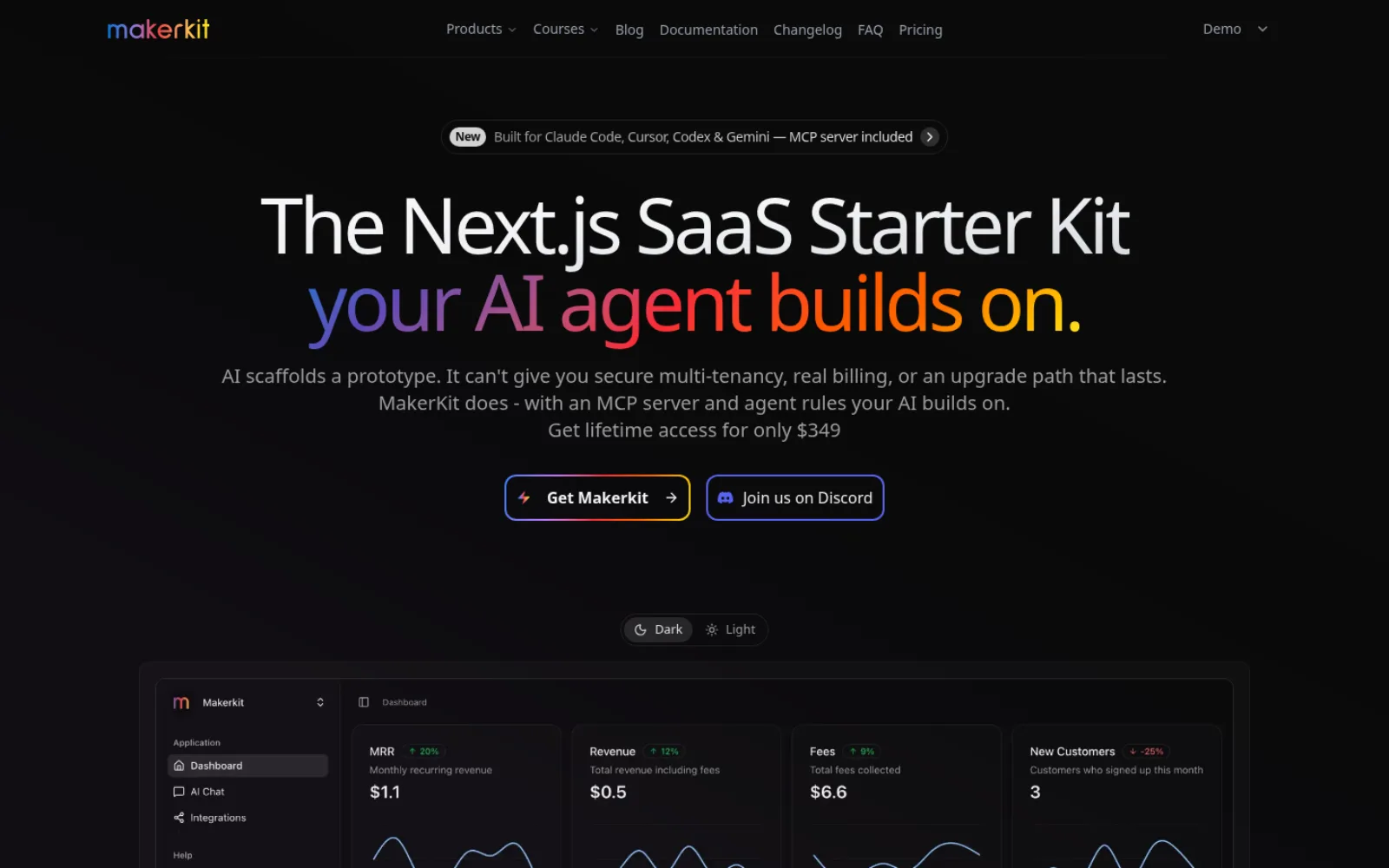
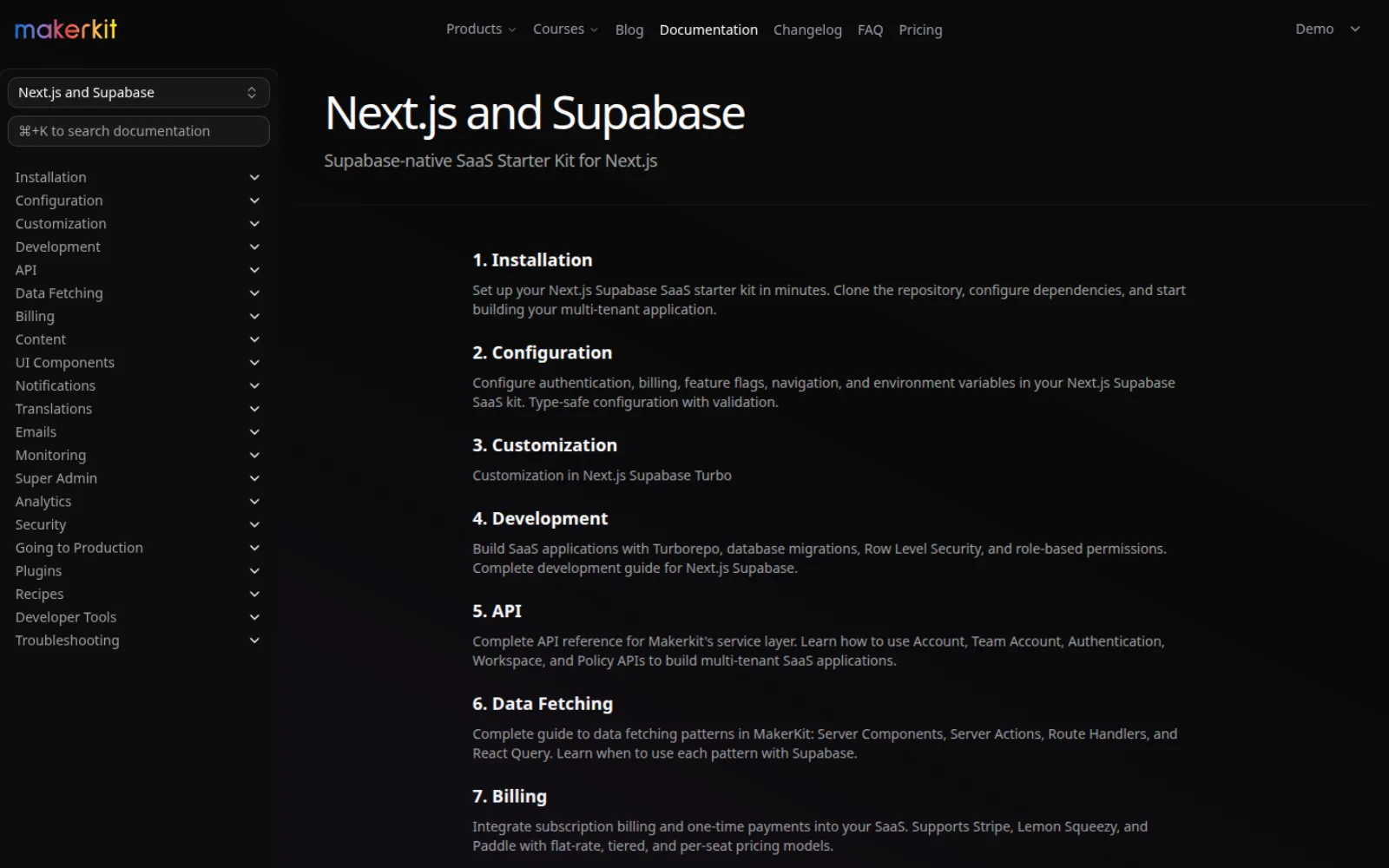
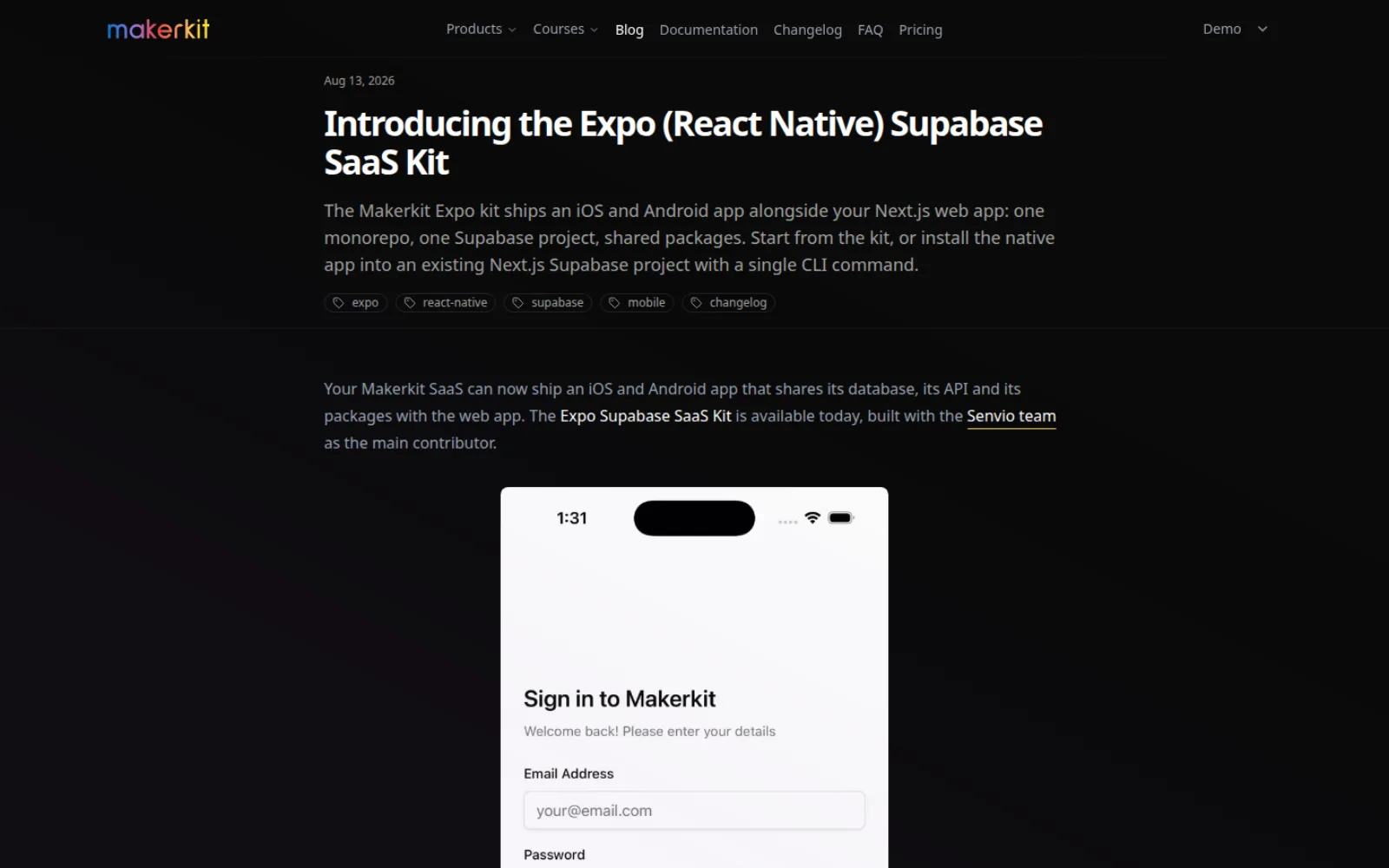
Makerkit homepage: Next.js SaaS starter with organizations, billing, and a super-admin, from $349.
Makerkit is built by Giancarlo Buomprisco for developers who need more than a basic landing page and single-user login. While many boilerplates stop at individual accounts, Makerkit centers around multi-tenant organizations, role-based access, and team subscriptions right out of the box. Its flagship boilerplate runs on Next.js 16 and Supabase with Stripe, a super-admin panel, and a Turborepo monorepo. Giancarlo also sells dedicated boilerplates for TanStack Start, React Router, Expo, and Next.js with Better Auth (using Drizzle or Prisma), though each stack requires its own license.
Where Makerkit stands out for modern development is its AI workflow. The boilerplate includes configured AGENTS.md rules for tools like Cursor and Claude Code, along with its own custom Model Context Protocol (MCP) server. Because your coding assistant can inspect the monorepo's architecture, database schemas, and conventions directly, you can prompt your AI tool to scaffold features or wire up Server Actions without it hallucinating file paths or breaking architectural boundaries.
If you want to test the interface before buying, you can click through live demos for each stack via the 'Demo' dropdown on makerkit.dev. You can also inspect the codebase directly: Makerkit Lite is a free open-source repository on GitHub that uses the exact same Turborepo structure, giving you a clear view of how the project is organized before committing to a paid tier.
Pricing is a one-time fee. The Pro license costs $349 for a single developer, while Teams is $649 for up to five team members and private Discord support. Both tiers include lifetime updates and unlimited projects for the stack you license. If you need to add teammates to a Pro license later, extra GitHub seats cost $99 each.
When deciding between boilerplates, the choice largely depends on your product model. If you are launching a simple B2C tool or a quick solo MVP, ShipFast is cheaper and simpler because it skips team accounts entirely. If you need multi-tenancy, supastarter is Makerkit's closest peer at $299 Solo, supporting multiple payment providers on a single purchase. Makerkit is the stronger fit if you want a dedicated super-admin, deep Supabase Postgres Row Level Security, and first-class mobile support through its Expo integration.
What's included with Makerkit
- Email, magic link, passkeys, OAuth, and TOTP MFA authentication
- Personal accounts plus organization accounts, invites, and custom roles
- Stripe billing (Lemon Squeezy and Paddle on Supabase boilerplates)
- Super-admin for users, organizations, impersonation, and subscriptions
- Marketing pages, blog, docs, and i18n
- Shadcn UI, Tailwind CSS 4, and a Figma UI kit
- Dedicated Makerkit MCP server and AGENTS.md rules for Cursor and Claude Code
- Playwright tests and React Email
- Expo plugin for the Next.js and Supabase boilerplate (released 13 August 2026)
- Lifetime updates and unlimited projects on the boilerplate you licensed
Our review
Makerkit pros and cons
Pros
- Organizations, roles, and a super-admin in the paid boilerplates
- Dedicated MCP server and AGENTS.md rules for Cursor and Claude Code
- Next.js 16 plus Drizzle, Prisma, TanStack Start, React Router, and Expo variants
- Public per-stack docs and a changelog dated through 13 August 2026
- One-time Pro $349 / Teams $649, unlimited projects on that boilerplate
- There is a free Lite MIT repo, so you can see how the Turborepo is put together.
Cons
- Separate license per stack
- Turborepo architecture has an initial learning curve, though AGENTS.md conventions help AI tools navigate it
- No refunds once you redeem access
- Extra GitHub seats cost $99, and the Pro license is for one GitHub seat
Best for
TypeScript founders building B2B SaaS with team workspaces and role permissions.
Skip if
You want a cheap single-workspace MVP or one license that covers every stack.
Score breakdown
- Features: 4.8 out of 5
- Paid boilerplates include organization accounts, roles, Stripe billing, a super-admin, translations, Playwright tests, a dedicated MCP server with AGENTS.md rules, and Expo on the Supabase line. Polar shows up on the Better Auth boilerplates, but it is a poor match if your customers pay per organization. The old Firebase boilerplate is gone.
- Value: 4.3 out of 5
- You pay once, and projects are unlimited on that boilerplate. Lite is free. Pro at $349 sits above ShipFast at $199 and supastarter Solo at $299, and a second stack is another license.
- Docs & updates: 4.7 out of 5
- The docs are public and split by stack, including a Next.js 16 migration guide. The last dated changelog entry is 13 August 2026, when Expo landed.
- Ease of use: 4.2 out of 5
- You follow the install docs and start the app. The included MCP server and AGENTS.md conventions help AI tools navigate the Turborepo quickly. Live hosted demos are linked in the website navigation, and Lite is free if you want to inspect the repo before buying.
- Community & support: 4.4 out of 5
- The community will help you in the Discord server. The contact page says they reply to tickets within 48 hours. If you buy Teams, you also get a private Discord channel with the Makerkit team, not only the public server.
Paid boilerplates include organization accounts, roles, Stripe billing, a super-admin, translations, Playwright tests, a dedicated MCP server with AGENTS.md rules, and Expo on the Supabase line. Polar shows up on the Better Auth boilerplates, but it is a poor match if your customers pay per organization. The old Firebase boilerplate is gone.
You pay once, and projects are unlimited on that boilerplate. Lite is free. Pro at $349 sits above ShipFast at $199 and supastarter Solo at $299, and a second stack is another license.
The docs are public and split by stack, including a Next.js 16 migration guide. The last dated changelog entry is 13 August 2026, when Expo landed.
You follow the install docs and start the app. The included MCP server and AGENTS.md conventions help AI tools navigate the Turborepo quickly. Live hosted demos are linked in the website navigation, and Lite is free if you want to inspect the repo before buying.
The community will help you in the Discord server. The contact page says they reply to tickets within 48 hours. If you buy Teams, you also get a private Discord channel with the Makerkit team, not only the public server.
Creator

Giancarlo Buomprisco
Follow on XPricing
Pro
Popular$349
One-time · One GitHub seat, unlimited projects, lifetime updates on that boilerplate.
- One GitHub seat
- Unlimited projects
- Lifetime updates on that boilerplate
- Organizations, billing, and super-admin
Price last checked: September 14, 2026
Documentation
Alternative boilerplates
If Makerkit is not the right fit, these are the closest alternatives based on pricing, features, and use case.

ShipFast
ShipFast is cheaper and has no organization accounts, so it fits a single-workspace Next.js MVP.

supastarter
Best overallsupastarter is the closest peer: a Turborepo with organizations, and more payment providers on one license.
Related articles & comparisons
SaaS Boilerplates
How to choose a SaaS boilerplate
A SaaS boilerplate provides prebuilt authentication, billing, and marketing layouts. Choose based on your tech stack, your account model, and your long-term maintenance overhead.
SaaS Boilerplates
8 Best SaaS Boilerplates in 2026
Compare the top SaaS starters, templates, and boilerplates for Next.js, Laravel, and Django. Ranked with Huzzler Scores, pricing, and who each boilerplate actually fits.
SaaS Boilerplates
What is Turborepo? A practical guide for founders
Modern SaaS boilerplates use Turborepo monorepos. Here is what that means for daily development, and whether the learning curve is worth it for your startup.
Frequently asked questions
Is Makerkit a subscription?
No. Pro is $349 and Teams is $649, each a one-time purchase with lifetime updates on that boilerplate. Extra GitHub seats are $99. Makerkit Lite is free.
What stack does Makerkit use?
The flagship is Next.js 16 with Supabase. Next.js Drizzle and Prisma boilerplates use Better Auth and your own Postgres. TanStack Start and React Router boilerplates exist too. Expo was released on 13 August 2026 for the Supabase line. Each boilerplate is a separate license.
What is the difference between Pro and Teams?
Product features match. The Pro license is for one GitHub seat. Teams allows up to five members and adds a private Discord channel.
How does Makerkit compare to supastarter?
supastarter is the closest peer: both are Turborepos with organizations. Solo is $299 with more payment providers on one license. Makerkit Pro is $349 per boilerplate. We score supastarter higher overall.
Does Makerkit offer refunds?
No. After you redeem access, Makerkit does not refund.
Does one purchase include every boilerplate?
No. Each stack is a separate license. Lifetime updates stay with the boilerplate you bought.
How does Makerkit support AI coding tools?
Makerkit includes configured AGENTS.md rules for tools such as Cursor and Claude Code, along with its own custom Model Context Protocol (MCP) server. Your AI assistant can inspect the monorepo's architecture, database schemas, and conventions directly to build features accurately.
Sources & research
Claims in our review are checked against primary sources, changelogs, official documentation, and founder updates.